Let’s talk about using foam as your upholstery padding material.
If your first project is a chair or sofa built in the last 30 years, you’ll likely find more foam inside and less cotton. Your older pieces were likelier to have cotton as their main upholstery padding. Even older chairs and settees had multiple forms of padding, such as horse hair, hog hair, coir or coconut fiber, moss, and straw, which upholsterers working for museums still use today.
Today’s furniture paddings consist of cotton, foam, and dacron.
My earlier blog on “Upholstery Padding” discussed natural and synthetic upholstery cotton and bonded polyester batting. Now, let’s talk about foam and foam choices.
A Lesson in Foam …
When buying foam for your project, you’re looking at three things.
- density (quality) – a measurement of how compact foam cells are relative to their size
- Higher density = better quality and the longer it will last
- compression (softness/firmness) – the higher the number, the firmer the feel
- The compression number denotes the amount of pounds it needs to compress the foam to 25%
- Also referred to as Indentation Load Deflection or ILD
- The higher the number, the firmer the feel
- resiliency (longevity) – is how springing a foam is
- Foams rated as having higher resilience (HR) means the faster the foam returns to its original shape. Also better quality
Foam ratings have four numbers. Example: 2635 (2.6 density with a medium firm 35 lb. compression)
Density—The first two numbers tell you the density, which is the quality and durability of the foam. Foam with a density rating of 1.8 (or 18) has less mass and is less dense than foam with a density rating 2.6 (26). Higher-density foam is better and more durable.
I like to use 2.6 or 26-density foam or higher, which is a high-density foam. Your supplier’s “better” foam” (high density) might start at 2.2, which is still a good quality. You can also find even higher densities like 3.3, which, as we’ve discussed, is much better. Anything above 2.6, I’d considered better quality foam, with more foam cells packed inside a cubic foot. A higher density number is a higher quality foam, and your project will look and feel good longer. Ask your supplier for a better foam, and ask what the density rating is. Look for a foam density above 2.6.
Compression—The second set of numbers on a piece of foam tells you how soft or firm it feels.
- 16 pounds of compression is considered a super soft foam often used for back cushions. You’ll be able to compress that pretty easily. The super soft foam has a density of 1.6 and is typically used for inside back cushions on furniture.
- 33-35 are medium to medium firm foams appropriate for furniture seating.
- 40 would be considered firm.
- 60 would be considered extra firm
Most of the time, I prefer 2635 foam from my supplier. 2.6 density (26) and 35 (medium firm) resilience. Remember, the first pair of numbers is quality, and the second refers to firmness.
However, the foam thickness affects the feel. Remember, the compression is how much pressure it takes to compress the foam 25%? Well, 25% of 6” is much different than 25% of 2”. For this reason, I would use firmer compression foam when I put 2” foam on seats or in a cushion, and use softer compression on 6” foam. Another option, if you need a thicker foam, is to combine or sandwich foams, placing the firmer piece in the middle and softer pieces on top and bottom. Keep that in mind when you’re deciding what works best for your project. You can always ask for help in the community forum as well.
Download the form for cushions HERE
Active Foam has some great information on their pdf Catalog starting on page 19,
When you get furniture from a store, they’re not always using high-density grade foam. Some consumers pay for an upgrade to high-density foam. If you buy good fabric and fill your project with quality fills and high-density foam, you might get 15-20 years or more out of your upholstery. (** Disclaimer—this does not mean that kids, pets, parties, and life won’t happen to your furniture!)
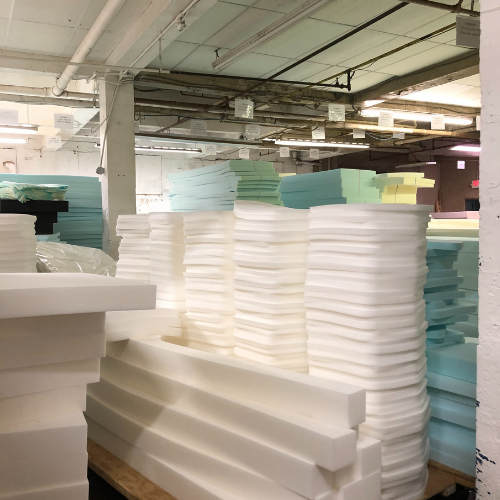
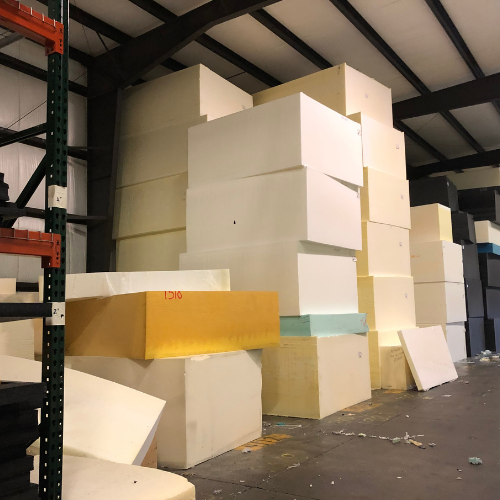
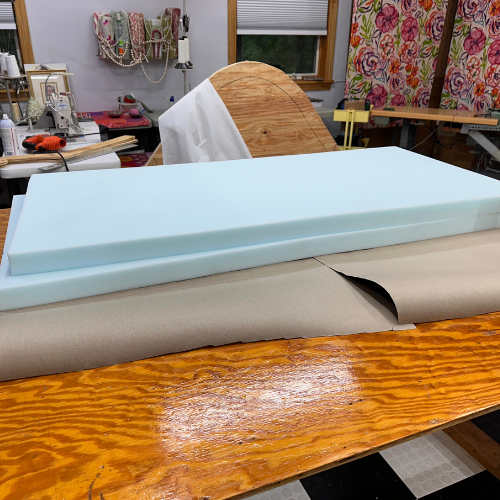

In our online class videos, you will notice that I prefer cotton as a fill over foam, but I show both methods. There are a few reasons why upholstery cotton is my preference:
- Cotton has a longer life span than foam
- Quality foam typically lasts 10 to 20 years before losing its resilience. The heavier the family member, the more quickly this occurs.
- Cotton allows me more control over the result.
- I can contour areas such as the lumbar back support or headrest.
- I have total control over the depth of my padding.
- Cotton is far less expensive than foam, which is petroleum-based and increases with oil prices, although you can find soy-based options, which are again pricey.
- Storing foam takes up much more space than several rolls of cotton.
. Foam has a relatively short life cycle compared to upholstery cotton. A high-density, high-resilience foam might last 10-20 years before losing its resilience. Most of what’s being put into factory-made furniture today is NOT high-density, high-resilience foam. I prefer cotton because I have more control over my results. I can add extra detail where I need to create contours and areas, such as the lumbar portion of the back, for a more comfortable feel. I also feel it holds up longer than foam.
This has helped give you a little more understanding of foam and will help you choose. Don’t forget to check out the blog on upholstery cotton as well. Read Now